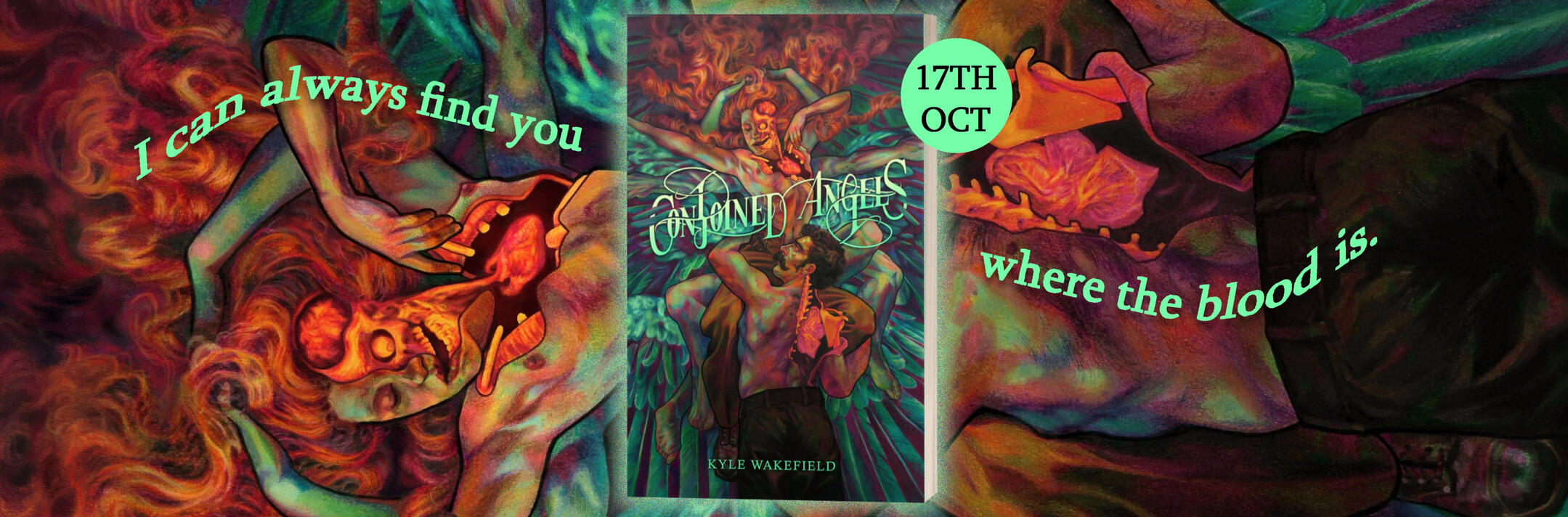
CONJOINED ANGELS
CHAPTER I | THE BLUE
THE BLUE THING, having hit the ground above the storm cave with a BOOM which punctuated the wind, is lying in the wheat field behind Jamie Fugate’s house with one of its wings resting on the roof. Two feathers at its tip forked around the chimney, the wing hackles the roof’s spinal column of orange tiles and descends out of sight in the right place to cover his bedroom window. The other wings fountain out of the wheat like the petals of a blue azalea.The storm was announced on the radio at dawn and brought juniper dark over the red plains at noon. Sitting with his parents in the subterranean cold of the storm cave with the gale hammering and sheeting the outside world, Fugate prepared himself for the part of the storm he was dreading the most: He pictured the places in his office where he’d find his briefcase and bandages, knocked on his thigh as if knocking at a door, and mimed greetings with his tongue in his closed mouth. I’ve got to go see if people are hurt. You hit your head or your belly? How hard did you hit your head? He pictured himself running down the street to the rescue and squeezed his nose against his glasses in embarrassment. He fretted about injured neighbours. The ones too injured for him to help and the ones just injured enough to ask for him first.The BOOM was more keenly felt by the hill than by him. He remembers that, as he bent his cramping wrist against his thigh, the storm cave seemed to shake around him independently of him, like he’d been tossed an inch into the air above his bench just beforehand. Resettlement into his seat after the impact was the resettlement of his knuckles into the knock. It’ll come back as a concussion tonight, he supposes. He’ll sit in the dark because the gaslight is digging at his eyes or dry-heave over the bathtub. As the sound of it landing didn’t interrupt the rehearsal, the sight of it lying there, massive and blue and uninvited, will not interrupt the deed.“Oh,” Fugate’s mother says from behind him. She’s only just emerged from the storm cave. He wants to see her face, but he doesn’t want to show his want by turning around. The thought of her looking at it as well, in the same way he is looking at it, makes him wild with rage.Without thinking, he replies, “Hay came out the roof.”The house is undamaged. So are the houses at the bottom of the hill, whose orange roofs gaze placidly up at him. The storm was pot-bellied and so low it crawled, but its confident conjuration of a tornado seems to have failed. If the wind had ripped the insulation from the roof and tossed it into the wheat field—in long blue wings and with the concentrated impact of a comet—he would never have stopped in his hurry to mention it. What bore mentioning was the delusion that nothing more remarkable had happened. No—the delusion that he hadn’t noticed.“I’ve got to go see if people are hurt.”The town of Cosset is jaundiced by the light which hangs like city smog beneath the clouds. It’s three o’clock in the afternoon, but the sienna fields and white and orange houses are ceilinged away from the sun by the clouds as surely as the planet floors them away from it at night. In the gloom, the wooden verandas and dirt track gleam with half-melted hail. The storm creaks on the northern horizon like retreating boots in underbrush. As he walks down the track with his briefcase, Fugate enters the thrall of a louder noise: The screaming of horses, herded into their barn from their paddock. In his mind, Fugate collapses the barn on top of them, shuts them up. When he sees the crowds of people greeting each other in his path and hears the children wailing through the open front doors, he collapses the houses too. Rolls the two rows to meet in the middle.The mess made of Cosset is decorous. There’s a steel trash can upside-down in the street, a bridle hanging like a brown snake from someone’s dead walnut tree. A neat rectangle of earth by the flour mill is finely furred with hay, as if the wind scalped the floor of a barn and set it down to go back for the walls. The radio orders the people in the path of a storm to open their windows and doors so that the wind passes through their houses instead of shoving itself whole against them, and Fugate sees no evidence of obedience save the open doors of the people in the street. Still, the houses stand.For no better reason than that it’s the door he rehearsed knocking at in the storm cave, his destination is the home of a pregnant patient. He knocks, and the patient’s husband calls from a distance: “Who is it?”“It’s Mr F-Fugate,” Fugate calls over the screams. The rehearsals never save his throat from twisting. “I’m just checking on Mrs Gebhart.”Closer to the door, the husband says, “Well, why don’t you come on in and take a look?” He opens the door. “I put her in the tub.”Fugate finds the woman in the kitchen, lying on her side in the claw-footed copper bathtub. She doesn’t move as he approaches. Once he’s standing over her, she turns her head.“Hello, Mrs Gebhart.”“Is it gone?” she says.“You hit your head or your belly?”“Hello. No. Is the twister gone?” Her speech is a jumble like his, shaken out of the right order rather than stringent to the wrong.“There wa’n’t one,” says Fugate.“Oh. George told me to get in the tub.”“I put the mattress on top of her.” The husband smacks a straw mattress which stands upright against the stove.“And yourself on top of the mattress?” Fugate says.The husband nods proudly.“Bring her to the storm cave next time.” Fugate kicks one of the bathtub’s copper trotters. “Ain’t no bathtub saving you unless it’s bolted to the floor. That spiel’s for city folk.”He always thought the same was true of the spiel about opening your doors and windows. That it’s for rich folk. How can Cosset’s people square the possibility of their houses blowing down with the certainty of their belongings blowing away and, with the threat of ruin equal in the absence of any one thing, choose the certainty?On the stoop, aided by what little daylight penetrates the clouds, Fugate checks the family for concussion symptoms. He asks them whether their heads hurt—they don’t—and whether they feel tired or confused—they don’t, but they sound it. Fugate thinks he must sound it too. He’d swear he feels his brain swelling against his optic nerves and the roof of his mouth.“Say,” says the husband. “Nothing fell down your end, did it? We heard this huge boom.”The blue thing drapes its wings over Fugate’s thoughts. Presses on them like an elbow on a windpipe. Brings an omen of inertia, breathlessness.“Trash can fell in the street,” he mumbles.No sooner does Fugate descend from the stoop than another neighbour rushes up to him. When she leads him to an unlighted front door from which the barking of men and screaming of children is issuing, presumptive annoyance replaces the relief of being wanted. After storms, for every person Fugate finds trapped under a table or cut by broken glass, there are ten who lead him to children whose only injury is fright.His presumption is wrong, and there are injuries. Two households with eight children between them threw them into the long kitchen cupboards with the parents holding hands against the doors, and the children are grazed and bruised from being shoved and scrambled over. As he works on one child after another, pouring his saline, cleaning the open wounds, and placating a hysterical adult with the pinkened rag, the shutters inside him blow and bang with the noise; so much terror compressed by such a low ceiling is a sinus ache. Against his hopes, the lessening of the crying only makes room for new terror. Toddlers use their first language to ask their mothers about the, “Big Crash,” and the screaming of the horses in the barn becomes audible again.He has a lone spike of thought, like a stitch in his ribs, that he badly wants Amon Jessop. Jessop is a veterinarian from Crook, a town ten miles down the track, the only other medical man within reach besides Fugate’s own retired father. Fugate doesn’t want help, but he wants a partner in failure. Someone to clap him on the shoulder when he finds a neighbour in pieces on the plains and say, Wasn’t your fault. You can’t be everywhere at once.A man runs up the steps to the house, pushing through the watching crowd with enough violence to make them stumble and shout. Fugate doesn’t notice the blood on his hands when he rests them on the doorframe but when he removes them again, leaving dark stains which in the mossy light look green.“Fugate!” the man cries. “My daughter. Fell down the stairs. Please! There’s so much blood.”
Fugate leaps to his feet. The thought the blood inspires, two dark fists beating to death the blue ghost, is Thank God.The woman is lying on her back at the bottom of her veranda stairs, in a sunset pool of blood and melting hailstones. The long arcs of saturated blonde hair look like spilling brains, the red and pink rills of diluted blood blown by the gale far along the track and up the stairs. As he led Fugate to her, the father explained that she lay unconscious for the worst of the storm with her parents pinning her down, and when they arrived, Fugate saw that the mother was still holding her position. She is lying over her daughter’s head and face with her arms wrapped around the banister, shuddering with effort, as though she can’t tell the wind has stopped.Bloody hailstones crunch under Fugate’s bootheels as he kneels down. The mother still doesn’t sit up.“Is it gone?” she sobs into her daughter’s yoke. “The twister?”“There wa’n’t no twister,” says her daughter from underneath her.Fugate puts his hand into the mother’s face and pushes her out of his way. The daughter stares pleasantly up at him from the floor, her eyes murky with burst blood vessels and reflected storm clouds. Her white face and the yellow roots of her hair are startling in the red pool, a noonday sun in the sunset sky.The horses are still screaming. Fugate thinks he hears the screaming interacting with a throaty rattle, as if they are striking their heads against the stable doors.The cut is a vertical eye down the back of her head, along the parting of her hair. It is already trying to squint itself shut. The amount of blood, alarming though it is, has been made to look more alarming by the wind and rain.“Did you move her?” says Fugate.“We cou’n’t,” says the father. “We were coming to the storm cave, but she was bleeding, and it was too late!”“Did the wind move her?”“I don’t think so.”Fugate endeavours to believe him. Like a forensic analyst, he tries to decide whether the wind should have only blown the blood along the track in one direction. It has blown in all directions, a splatter flicked by a brush in Heaven. Maybe God made a tornado after all, for just long enough to make it symmetrical.“She’s not dying, then.” Fugate shakes saline and a rag into his lap. “She’ll have to lie here tonight.”“But she’ll be cold!”“Get her a blanket.”“And a pillow?”“If I place it. You’ll shake loose a brain bleed.”He compresses her head violently, ring finger pushing down on her forehead. She stares serenely up at him, less upset than the unhurt woman in the bathtub. He sits with her in the blood for so long that his soaked ass and thighs start to itch, and he ponders asking one of the bystanders to push his glasses up his nose and pull back his hair. The storm interrupted nothing—he and his parents spent the morning triangulated around the radio in his office, coiled to spring to the storm cave—but he looks like it surprised him in the middle of dressing, with his shirt hanging like a white cravat down his pant leg and his hair loose. Long and heavy and as red as the clay seeping up at the edges of the track, with a single oiled curl at the apex of his forehead, satirically placed, like that fine leather bridle hanging from that sun-bleached walnut tree.Beneath his hand, the woman’s murky eyes shimmer blue and roll to follow something across the sky. When he unthinkingly looks up as well, he finds himself squinting against a blinding light. The sun is shining down from the green clouds in white bands, a canopy hung from a hoop. All at once, Fugate understands why descending into Cosset an hour ago from his house felt like descending into darkness.There’s a perfectly round hole in the clouds, drifting north in the wake of the storm. It’s a cerulean wound in dark green hide, with pale edges swollen thick or rolled down, as if pulled open by pins. In the blue sky beyond the porthole, Fugate sees white cirrus clouds which seem to hail from a different season than the storm clouds, if not a different world.Everyone in the street is staring up at it. It’s like the tornado did come down, only to be surgically removed from the thunderstorm before it reached Cosset. Slit out of its socket like a tooth.Left behind by the ambulatory shaft of sun, Fugate senses something which washes him all over with peace. At first, he thinks it’s the light, or the warmth of it. But it was noise, not darkness or cold, which got its claws into him after the storm.The horses have stopped screaming. He can hear the neighbours in the street chattering, and the few children still crying.
Fugate wants to lie down on his back and fall asleep. A thought strikes him dumber: For why be a doctor if not to stop the screaming?Instead, he rolls his eyes at his patient and says, “The veterinarian’s here.”As if called, Amon Jessop wanders onto the track from the direction of the barn not a minute later. He is recognisable ten verandas away, black-suited in the afternoon heat, with a belt of saddle bags folded in half over his shoulder. Jessop staring around like he’s lost, Fugate craning forward to peer down the track, the two recognise each other at the same time. When Fugate makes a noise of disgust and bows his head, his patient tries to get up to look too. He pushes her back down onto the rag with two fingers.Jessop arrives at the veranda to the sight of Fugate on his knees, bloody to the elbows, blinking dumbly in an attempt to replace a dazzling blue retinal mass with Jessop’s face. Jessop’s appearance, if not his nature, is a braggart of a most obnoxious manliness: He is tall, big-bellied and broad-shouldered, with a Roman nose and an enormous black moustache tapered up on
both ends like an earwig. There are bits of black bug all over him, summer-gnat moles on his face and tiny eyes which sparkle like scarab shells when he smiles.“I can always find you where the blood is,” Jessop says cheerfully.Fugate screws up his nose, tries to wriggle his glasses higher. “What d’you want? D’you need me in Crook?”“Can’t say we do. Figured you might need me here. We heard—”Fugate thrashes his head. Knocks the blue thing off its roost again. “I do,” he snaps. “I need you to check the houses. I’ve got a head to staple shut.”Jessop looks queasily at the pool of blood. Then, he salutes Fugate with two fingers.“If someone’s hurt, get me,” Fugate adds. Then, when Jessop still doesn’t leave: “If someone’s just screaming, pretend they’re a pony.”Jessop smiles bashfully. “Oh, well,” he says. “I meant to just put Miss Anna Bertha in the paddock, but they were awful upset, so I figured I’d stay a while and—”“I don’t care. See if it works on babies.”Anna Bertha is Jessop’s horse. A massive shaggy carthorse who nuzzles and frolics like a dog. What Jessop did to make the horses stop screaming was ask them to. If he hadn’t come looking for Fugate, the stablemaster would have found him asleep in the barn with their noses in his lap.Jessop smiles, quirking his moustache. “Okie dokie.”As he walks away at last, Fugate unholsters his stapler from his briefcase. The steel shines green in the light of the retreating storm, verdigris-dull.His patient is staring up at him in amazement. He supposes she compares the prediction of a veterinarian by the shutting up of horses to the prediction of rain by the lying down of cows.
“He must’ve heard it all the way from Crook,” she says.“Heard what?” says Fugate.“Wa’n’t there a big BANG? Daddy said there was a big BANG. He was trying to work out what fell over. D’you think maybe it fell from all the way up there? Where the hole was?”Fugate fixes the stapler into the nape of her neck. “I’m gonna count to three.”As he staples, the crowds in the street ebb and flow around Jessop. The veterinary radiologist’s skill for holding down squirming, biting things extends from his hands to his voice, and Fugate watches him placate shouting adults and chatter with tearstained children with an emotion which settles in his head like contempt and in his stomach like jealousy. Jessop is twofold an interloper, an interloper this day from another town and this decade from seven years at veterinary college in Philadelphia, where he is rumoured to have been sent by some rich sister of one of his cow farmer parents. How he and his arsenal of preternatural radiology tools ended up back in Oklahoma Fugate couldn’t bear to know. He tells his patients that he assumes Jessop disgraced himself after he graduated. Had to flee from reputation or law. The patients must judge it a cruel assumption, but Fugate finds it more bearable than what he really thinks: That Jessop left to make the world a better place, but couldn’t resist the calling to make the dirt track he grew up on a better place first.When Jessop comes back to the bloody patch of road, evening is falling. The violet dark which collected above the thunderstorm is leaking down. The hole in the clouds is long gone, sewn shut with cirri and wheeled over the horizon.Fugate’s patient is asleep, bloodying a throw pillow decorated with cross-stitched mice which her mother brought. She will wake up with an oil-fire headache, and might not recognise her parents.“Are you okay?” Jessop says to Fugate’s back. “Can I get you anything?”Fugate bristles. At a time like this, there is no question ruder than Are you okay. He would have preferred Is she okay. He would have preferred Can I go home. He would have preferred What was that noise.Fugate drops his stapler into his briefcase. It sticks to his bloody palm for one, two, three seconds before it falls with a CLUNK.“There’s an angel. Fell on my house,” he says. “Come and see.”